The Sofa Fire Label: What Changed and What Remains
The swing label vanished in October 2025 and a smoulder test may replace open-flame testing. What the 1988 fire label rules require as of October 2026.
If you have gone looking for the cardboard swing label on a new sofa and found nothing, that is not an oversight. The requirement for manufacturers to attach a display label to new upholstered products was removed with effect from 30 October 2025. The sewn-in permanent label under regulation 11 of the Furniture and Furnishings (Fire) (Safety) Regulations 1988 was not removed and still applies. And as of October 2026 a much larger reform is pending: a consultation proposing to end open-flame testing in favour of a smoulder test closed on 23 June 2026 and the Government is analysing responses.
What the 1988 Regulations actually require
The Regulations, amended in 1989, 1993, 2010 and 2025, set required ignition-resistance levels for upholstery components and composites in furniture supplied in the UK. FIRA’s guide to the domestic flammability regulations, currently at Revision 2 (February 2026), summarises the regime as five elements: filling materials must meet specified ignition requirements; upholstery composites must be cigarette-resistant; covers must be match-resistant, subject to exceptions; a permanent label must be fitted to new furniture other than mattresses and bed bases; and the first supplier of domestic upholstered furniture must keep records for five years.
For anyone cleaning or caring for upholstery, the permanent label is the useful document — and not primarily for fire-safety reasons.
What the permanent label has to say
Schedule 7 to the 1988 Regulations sets out two alternative label formats, Part II and Part III. Both must carry the wording “CARELESSNESS CAUSES FIRE”.
A Part II label additionally carries the name and postal code of the principal place of business of the manufacturer or importer who first supplied the article in the UK; the batch or identification number, if any; the date of manufacture or import in finished form; a description of all filling materials; a description of all covering materials; and whether the article includes an interliner that passes the Schedule 3 test. A Part III label is shorter: the wording, batch or identification number, interliner status, and a summary of the measures taken to ensure compliance.
Schedule 7 also sets out the physical requirements. Wording and numbering must be in medium letters of at least 10 point, upper or lower case, legible and durable, on a background of sufficiently contrasting colour. The label itself must be durable and securely attached, must not obscure any label or mark required by another enactment, and for most articles must sit on an external surface. Where furniture is sold as a collection — a three-piece suite, for example — a label must be attached to each individual piece.
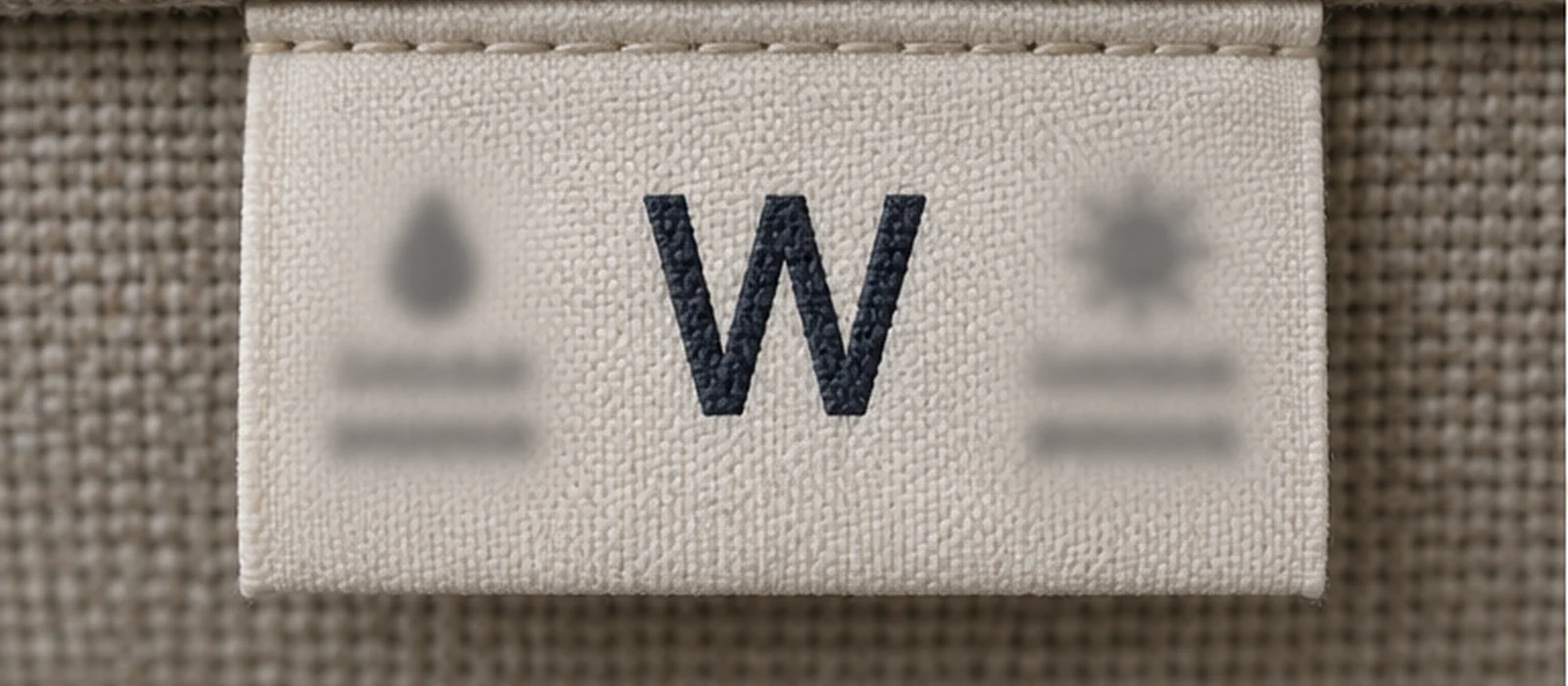
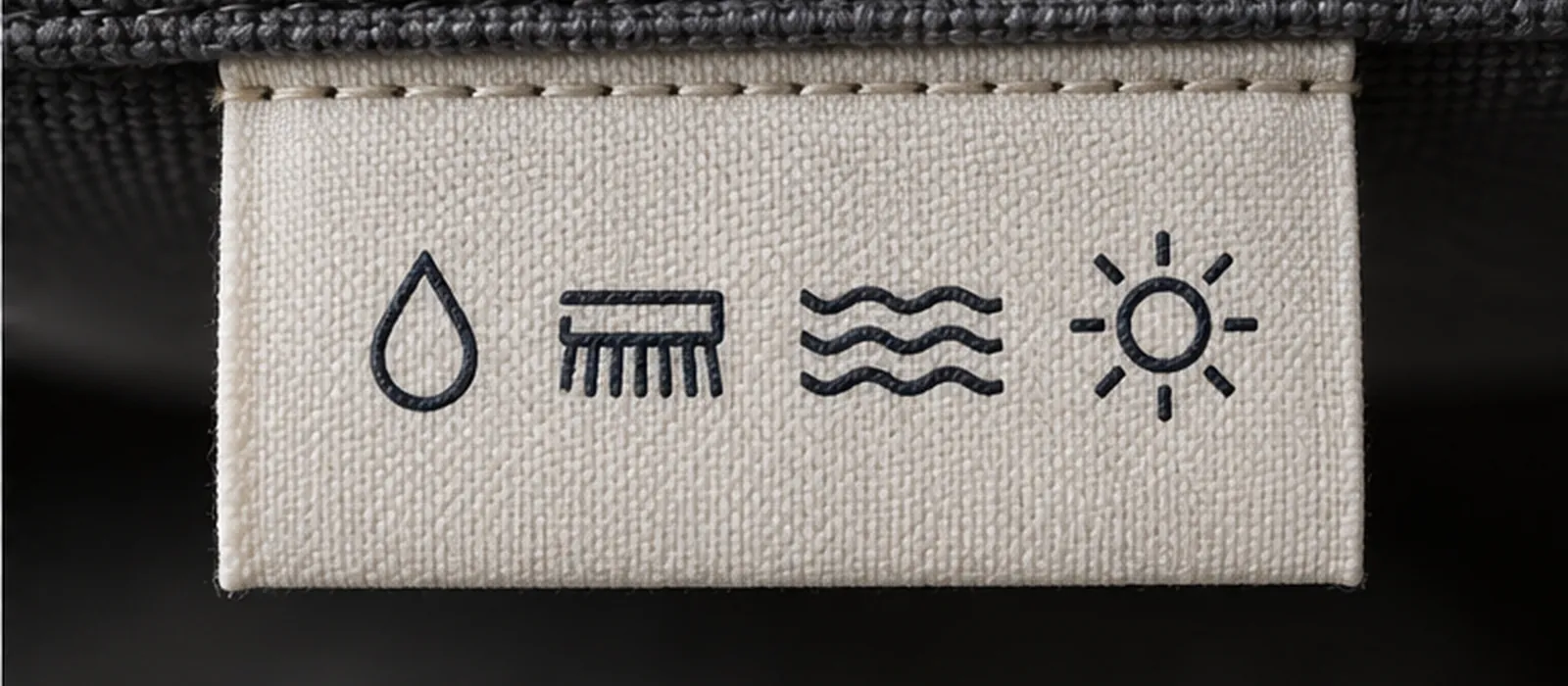
Two practical consequences follow. First, a Part II label is a materials declaration. Where you have one, you have the manufacturer’s own description of the filling and the cover, which is a far better starting point for choosing a cleaning method than a guess based on handle and appearance. Second, nothing in Schedule 7 requires cleaning instructions. The familiar W, S, WS and X cleaning codes are manufacturers’ own care labelling, not a statutory requirement under these Regulations — which is exactly why their presence, format and reliability vary so much between brands, and why a missing code tells you nothing about whether a piece is compliant.
The display label is gone
The statutory guidance on the Furniture and Furnishings (Fire Safety) (Amendment) Regulations 2025, published 30 April 2025, confirms what SI 2025/531 did. Three changes matter:
- The requirement for manufacturers to attach a display label, commonly called the swing label, to new products was removed. Permanent labels under regulation 11 and second-hand supply requirements under regulation 14 are unaffected.
- A list of baby and children’s products was removed from the scope of the 1988 Regulations — including mattresses under certain dimensions, prams, cots, play mats and highchairs — on the stated basis that “this will reduce the risk of exposure to chemical flame retardants of babies and young children”. Those products must instead meet the General Product Safety Regulations, which require fire safety to be considered.
- The time limit for starting legal proceedings was extended from six to twelve months across England, Wales, Scotland and Northern Ireland.
The Regulations were laid on 30 April 2025 and came into force on 30 October 2025, after a six-month deferral to meet WTO obligations. There is no transition period in the usual sense: businesses may continue selling existing stock of removed products, and products still bearing display labels, indefinitely, provided the labelling accurately reflects compliance. So a swing label on a sofa in a showroom in late 2026 is not a sign of anything wrong — it is simply older stock or a retailer continuing a practice that is no longer mandatory.
The bigger reform, and where it had got to
On 31 March 2026 the Office for Product Safety and Standards and the Department for Business and Trade opened a consultation, product regulation: fire safety of domestic upholstered furniture. It closed at 23:59 on 23 June 2026, and as of October 2026 the page states that feedback is being analysed and no outcome has been published.
The consultation document proposes a comprehensive replacement of the 1988 regime. Its three proposals are to “end open-flame testing requirements” and “introduce new regulations underpinned by a smoulder test aligning with international approaches”; to allow manufacturers to choose between composite (representative sample) and component testing; and to make scope adjustments. The stated aim is to maintain a high level of fire safety while meaningfully reducing chemical flame retardant use, with ending open-flame testing as the main lever for that. The Government also said it would not introduce the Flame Retardant Technology Hierarchy proposed in 2023, and that outdoor furniture would remain in scope.
Three points in the scope proposals matter directly to anyone working on existing furniture. Re-upholstery and repair would move from the sector-specific regulations to the General Product Safety Regulations, with guidance promised for the sector. Second-hand upholstered furniture would likewise be handled under the GPSR framework rather than the furniture regulations, the Government noting that a zero-risk approach would lead to serviceable furniture being disposed of. And re-upholstered products would have no mandatory labelling requirements — with the broader question of labelling and technical files deferred to a later policy response. Until that response appears, regulation 14 on second-hand supply still stands as written.
What this means in practice for upholstery care
The regulatory churn does not change cleaning chemistry, but it changes what information you can expect to find. Treat the permanent label as the single most valuable piece of documentation on a piece of upholstery and do not cut it off: a Part II label is your record of filling and cover materials, and once removed it cannot be reconstructed. Where only a Part III label is present, you have compliance information but no materials declaration, so fibre identification has to be done empirically — burn and solubility tests on a concealed sample, or a professional identification — rather than read off the label.
Expect the information picture on second-hand and re-upholstered pieces to get thinner, not richer, if the 2026 proposals are implemented as drafted. A piece that has been re-covered may carry an original permanent label describing a cover that is no longer on it, which is a trap worth checking for before selecting a wet or solvent method.
Frequently asked questions
Does my new sofa still need a fire label? It still needs the permanent label under regulation 11 of the 1988 Regulations. The separate display, or swing, label requirement was removed with effect from 30 October 2025.
Why do some sofas still have swing labels? Because the change removed an obligation rather than imposing a prohibition. The statutory guidance confirms businesses may continue selling products with display labels indefinitely, provided the labelling accurately reflects compliance.
Are the W, S, WS and X cleaning codes a legal requirement? No. Schedule 7 to the 1988 Regulations specifies fire-safety information, not cleaning instructions. Cleaning codes are manufacturers’ own care labelling, which is why their use and reliability vary.
Have the open-flame tests been replaced by a smoulder test yet? Not as of October 2026. The consultation proposing that change closed on 23 June 2026 and the Government is analysing responses; no outcome, draft regulations or implementation date has been published.