The fire-safety label on UK upholstered furniture
Why domestic upholstery sold in the UK carries a permanent fire label, which ignition tests sit behind it, and why the label is a reason not to improvise with covers and treatments.
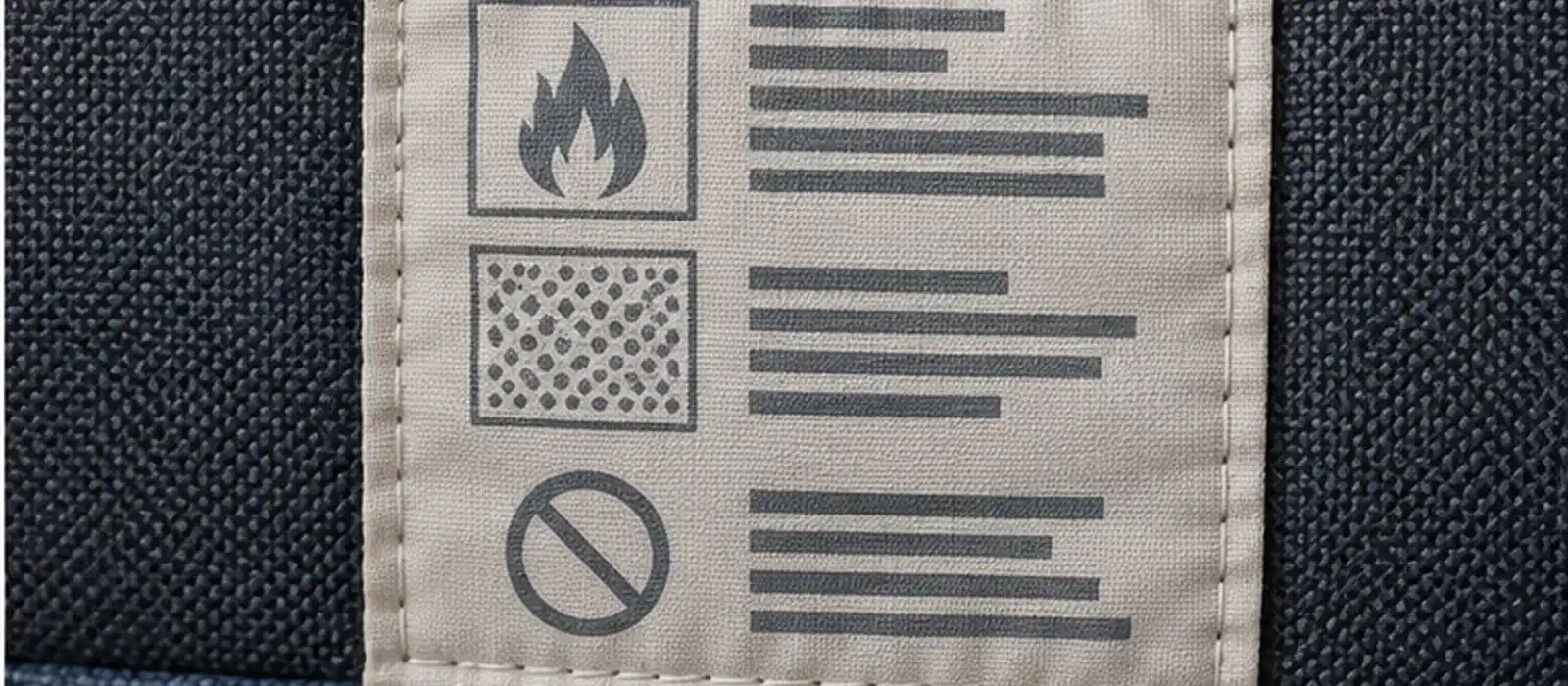
Upholstery in the UK is regulated for fire behaviour in a way that surprises people who think of a sofa as furniture rather than as a fuel load. The label is the visible end of that regulation, and it is worth understanding before anyone starts modifying a piece.
What the law requires
The Furniture and Furnishings (Fire) (Safety) Regulations 1988, amended in 1989, 1993 and 2010, require that upholstery components and composites used in furniture supplied in the UK meet specified ignition resistance levels and are suitably labelled. The stated purpose was blunt: reduce house fires caused by furniture, and save lives.
New upholstered furniture carries a permanent label headed “Carelessness causes fire”. As a minimum it shows that caution, a batch or identification number, whether the item includes a fire-resistant interliner, and a summary of the measures taken to demonstrate compliance.
There was historically a second, separate display or swing label attached at the point of sale, indicating ignition resistance. Following the Furniture and Furnishings (Fire) (Safety) (Amendment) Regulations 2025, which came into force on 30 October 2025, new furniture no longer needs that display label — the permanent label now carries the compliance information on its own.
Certain items sit outside the display-labelling requirement in any case: mattresses, bed bases, pillows, scatter cushions, seat pads, and loose or stretch covers sold separately from the furniture.
The tests behind the label
The ignition testing referenced in this area uses the EN 1021 series, which assesses whether a combination of cover and filling ignites when exposed to a defined ignition source. It comes in two parts:
- EN 1021-1 — smouldering cigarette. The test assembly must not still be smouldering an hour after the test begins.
- EN 1021-2 — match flame equivalent. The assembly is exposed to a gas flame equivalent to a match for 15 seconds.
The important detail is that the test is on the combination, not the cover alone. Fire performance is a property of cover plus interliner plus filling working together, which is why a cover cannot be assessed in isolation.
Why this belongs on a cleaning site
Three practical consequences follow, and all three are about care rather than purchase.
Do not remove the permanent label. It is the only record of the piece’s compliance, and it carries the batch number that identifies what was tested. Cutting it off because it is scratchy destroys information that cannot be reconstructed.
Recovering or reupholstering changes the tested combination. The certified assembly was cover plus interliner plus filling. Replace the cover and the assembly is no longer the one that was tested. This is a matter for whoever does the work, and it is one of several reasons reupholstery is not a casual job.
Be wary of adding treatments. Aftermarket sprays, protectors and home-brew stain guards are applied on top of a certified assembly by someone with no data on how they interact with it. That is a separate concern from whether they clean well.
What the label does not do
It says nothing about cleanability, fibre, or how to remove a mark. It is a safety certification, and it and the cleaning code answer different questions. Reading one for information about the other is a category error — the fire label will not tell you whether the fabric tolerates water, and the cleaning code will not tell you whether the filling passes a cigarette test.